
Self-Organising
Supporting teams to thrive beyond hierarchy
Self-organising is about creating the right conditions for collective intelligence, autonomy, clarity and trust to flourish.
I work in collaboration with Evolving Organisation, bringing together their deep practical experience with the people-centred, change-aware approach I’ve developed over years of Lean Change and leadership practice.
Self-organising teams are designed to respond to complexity, increase adaptability, and make better decisions faster – without unnecessary dependency on hierarchy or managerial bottlenecks.
What is Self-Organising?
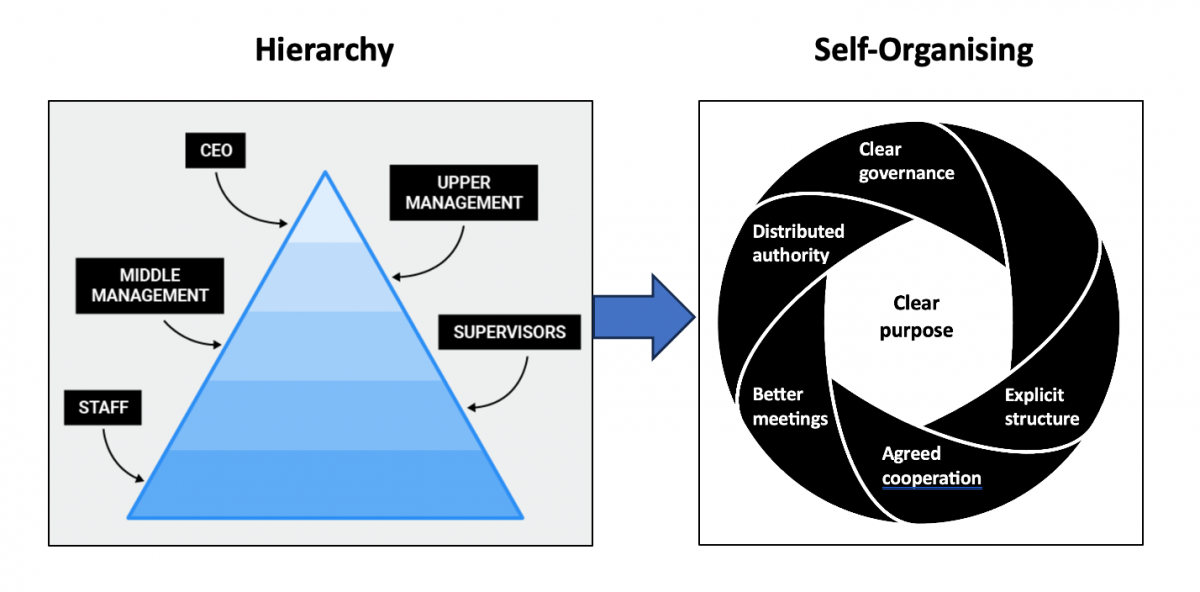
Self-Organising, or self-management, as it is sometimes known is a way of working that equips teams to take responsibility for their purpose, roles, boundaries and decisions, while still being aligned with organisational goals.
This means:
Clear roles and decision authority
Distributed accountability
Structured ways to surface and resolve issues
Continuous learning and adaptation
Instead of relying on managers to make or approve every decision, teams learn to self-govern around purpose, clarity and agreed ground rules. This reduces friction, speeds up execution and strengthens trust across the system.
Why this matters now
Many organisations know that traditional hierarchy isn’t working the way it used to – decisions take too long, people feel disengaged, and everyone struggles to keep up with change. At the same time, trying to implement self-organising overnight without preparation can create confusion, resistance or unintended setbacks.
That’s why we focus first on assessing readiness, experimenting carefully, and building real evidence that the approach works in your context.

Cross the Threshold: a practical starting point
Together with Evolving Organisation, I support teams to cross the threshold into new ways of working — not by mandate, but by pilot, evidence and clarity.
This means:
Assessing what’s really going on in your team and organisation
Understanding readiness — including team buy-in, stability, and capacity for change
Running small, low-risk experiments to test self-organising practices
Building a bespoke roadmap for what comes next — whether that’s a deeper self-organising journey or a decision to adapt in a different way
This is not a generic training course. It’s a guided, practical process to help you learn by doing, reduce risk and make decisions from real experience, not hope.
By working with us you gain:
Clarity around whether self-organising is right for you
A grounded understanding of your team’s readiness
Meaningful, contextual insights from real experiments
A clear, actionable roadmap for what to do next — whether that’s expanding self-organising, adjusting your approach, or strengthening your existing ways of working
What we can learn from termites
Termites self-organise through simple rules, environmental cues, and local interactions to build the largest structures on Earth relative to their size. They operate without hierarchy to build highly complex adaptive structures efficiently and cooperatively.

Together with Evolving Organisation, I support teams to cross the threshold into new ways of working — not by mandate, but by pilot, evidence and clarity.
This means:
Assessing what’s really going on in your team and organisation
Understanding readiness — including team buy-in, stability, and capacity for change
Running small, low-risk experiments to test self-organising practices
Building a bespoke roadmap for what comes next — whether that’s a deeper self-organising journey or a decision to adapt in a different way
This is not a generic training course. It’s a guided, practical process to help you learn by doing, reduce risk and make decisions from real experience, not hope.
By working with us you gain:
Clarity around whether self-organising is right for you
A grounded understanding of your team’s readiness
Meaningful, contextual insights from real experiments
A clear, actionable roadmap for what to do next — whether that’s expanding self-organising, adjusting your approach, or strengthening your existing ways of working
What we can learn from termites
Termites self-organise through simple rules, environmental cues, and local interactions to build the largest structures on Earth relative to their size. They operate without hierarchy to build highly complex adaptive structures efficiently and cooperatively.
How I support this work
I bring:
Deep experience in helping organisations build trust, clarity and participation as the foundation for change
A focus on practical application, not just theory
A commitment to working with you through real patterns of behaviour, not assumptions
Paired with Evolving Organisation’s expertise in self-organising systems and structured readiness support, this collaboration helps you move beyond hierarchy with confidence and evidence.
I bring:
Deep experience in helping organisations build trust, clarity and participation as the foundation for change
A focus on practical application, not just theory
A commitment to working with you through real patterns of behaviour, not assumptions
Paired with Evolving Organisation’s expertise in self-organising systems and structured readiness support, this collaboration helps you move beyond hierarchy with confidence and evidence.
Is Self-Organising right for you?
It’s a fit if:
You want teams that adapt and respond quickly in a complex environment
You want clarity, accountability and momentum without adding bureaucracy
You’re ready to experiment, learn and adjust
You want to build ongoing trust and engagement across the organisation
It’s not a fit if you’re looking for a quick fix, a one-size-fits-all template, or a passive online program without real engagement and reflection.

I highly recommend this course to any senior management team – or any team for that matter – that simply wants to work better, get more done and be happier in the process.
Our team is now working together more efficiently and we're getting more done.
It’s a fit if:
You want teams that adapt and respond quickly in a complex environment
You want clarity, accountability and momentum without adding bureaucracy
You’re ready to experiment, learn and adjust
You want to build ongoing trust and engagement across the organisation
It’s not a fit if you’re looking for a quick fix, a one-size-fits-all template, or a passive online program without real engagement and reflection.
I highly recommend this course to any senior management team – or any team for that matter – that simply wants to work better, get more done and be happier in the process.
Our team is now working together more efficiently and we're getting more done.
FAQ: Self-Organising